The Mindfulness Advantage: Presence as Your Superpower

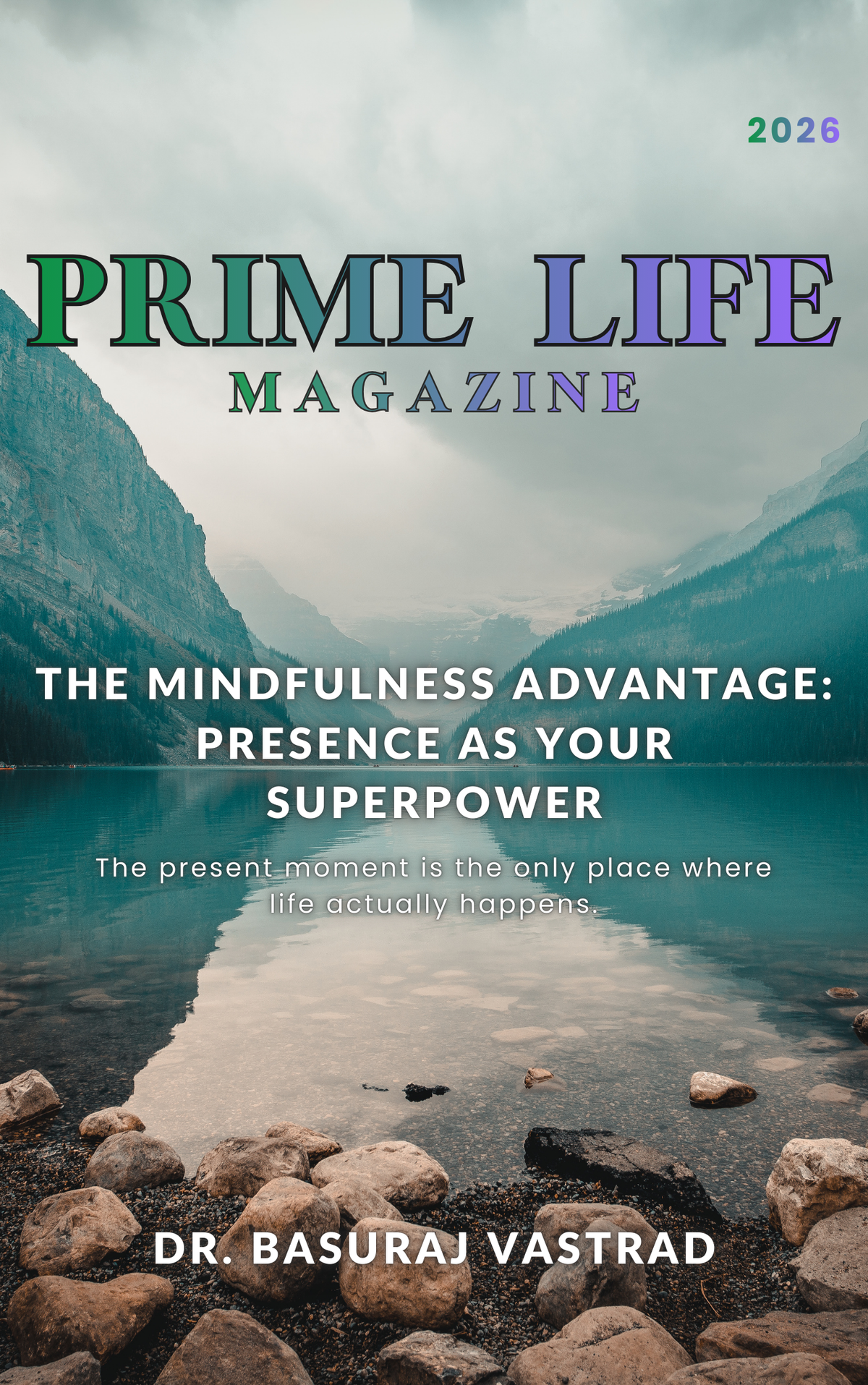
The present moment is the only place where life actually happens.
The surgery was technically perfect. Textbook precision. Yet the patient, fully healed physically, remained stuck in anxiety about the future and regret about the past.
"Doc," he finally confessed, "my hand works fine now. But my mind is still broken."
I recognized that particular suffering intimately — not from my patients, but from my own life. Years ago, I'd been so consumed with becoming a better surgeon that I'd missed actually being one. I was always mentally rehearsing the next procedure, reviewing the last one, planning, analyzing, anywhere but here.
I was physically present but mentally absent. And I was miserable.
That's when I discovered that presence isn't just a spiritual concept — it's a survival skill.
THE EPIDEMIC OF ABSENCE
Here's what nobody tells you: You can succeed at everything society tells you to chase — the career, the relationships, the achievements—and still feel like you're missing life itself.
Why? Because you're not actually here for it.
Research shows the average person spends 47% of their waking hours thinking about something other than what they're currently doing. Nearly half of life — just... gone. Spent in regret about yesterday or anxiety about tomorrow, while the only moment that actually exists — now — slips by unnoticed.
We're physically here but mentally elsewhere. At dinner, thinking about work. At work, thinking about home. With our children, thinking about email. In conversation, rehearsing our response instead of listening.
We're ghosts in our own lives.
The cost is enormous. Not only do we miss experiences we'll never get back, but chronic mental time-traveling correlates with:
- Higher anxiety and depression
- Lower life satisfaction
- Weakened immune function
- Impaired cognitive performance
- Damaged relationships
We're trying to live entire lives while barely showing up for any of it.
THE PRIME PRINCIPLE: MINDFULNESS
Mindfulness — the "M" in PRIME — is the practice of bringing your full attention to the present moment without judgment.
But let's be clear about what mindfulness isn't:
- It's not emptying your mind of all thoughts
- It's not being blissed-out and passive
- It's not escaping reality or bypassing problems
- It's not a religious practice (though it can complement any faith)
Mindfulness is simply showing up fully for your own life.
Think of it this way: You have a finite number of moments. Each one is irreplaceable. Mindfulness is deciding those moments matter enough to actually be present for them.
In my surgical practice, mindfulness isn't optional — it's essential. A surgeon who's mentally replaying breakfast or planning dinner while operating is dangerous. The scalpel requires presence.
But here's what took me years to learn: every moment is that delicate. Your conversation with your child requires the same presence as surgery. Your walk in nature deserves the same attention as a critical meeting. Every moment you're living is the only moment you'll ever live exactly like this.
Mindfulness is the practice of honoring that.
CULTIVATING MINDFUL PRESENCE
Step 1: Start With the Breath
Your breath is always with you, always accessible, always happening now. It's the perfect anchor for presence.
The 4-7-8 Technique:
- Breathe in through your nose for 4 counts
- Hold for 7 counts
- Exhale through your mouth for 8 counts
- Repeat 4 times
Do this once upon waking, once midday, once before sleep. That's it. Three minutes total.
This isn't about becoming a meditation master. It's about creating three moments each day where you're guaranteed to be present. Everything else builds from there.
One patient told me this simple practice helped her more than years of medication for anxiety. Why? Because she finally experienced what it felt like to be here, now. And from that foundation, everything else shifted.
Step 2: Practice Single-Tasking
Multitasking is a myth. Your brain doesn't do multiple things simultaneously — it rapidly switches between tasks, doing all of them poorly while exhausting you.
Choose one activity each day to do with full attention:
- Drinking your morning coffee (not while reading news)
- Taking a shower (not mentally planning your day)
- Eating a meal (not while scrolling)
- Walking (not while on your phone)
- Talking with someone (not while distracted)
Notice everything about that one activity. The sensations, the textures, the sounds, the feelings. When your mind wanders (and it will), gently bring it back.
This is the gym for your attention muscle.
Step 3: Create Mindfulness Triggers
We need reminders to return to presence because our default mode is mental time-travel.
Set up "presence cues" in your environment:
- Every time you open a door, take one conscious breath
- Every red light becomes a moment to check in with your body
- Every time you wash your hands, notice the sensation of water
- Every notification sound reminds you to pause and feel your feet on the ground
These micro-moments add up. You're training your nervous system to default to presence instead of absence.
Step 4: Practice Non-Judgmental Observation
Mindfulness includes the "without judgment" part for a reason. Most of us are constantly evaluating: this is good, that's bad, I like this, I hate that.
That evaluation pulls you out of experience and into interpretation.
Try this experiment: For five minutes, observe without labeling.
- Don't call thoughts "good" or "bad"—just notice them
- Don't label emotions "positive" or "negative"—just feel them
- Don't judge sensations "pleasant" or "unpleasant"—just sense them
You're not trying to change anything. You're practicing pure awareness.
This is radically different from how most of us operate. We're so busy judging our experience that we barely experience it. When you drop judgment, you access presence.
Step 5: Extend Mindfulness to Difficult Moments
The real test of mindfulness isn't during peaceful meditation—it's during stress, conflict, pain, or boredom.
Can you stay present when:
- Someone criticizes you?
- You're stuck in traffic?
- You receive disappointing news?
- You're in physical pain?
- You're having a difficult conversation?
This is advanced practice. But it's where mindfulness becomes transformative.
Instead of reactivity (automatic, unconscious response), you develop the space to choose your response. That space—between stimulus and response — is where freedom lives.
Viktor Frankl wrote: "Between stimulus and response there is a space. In that space is our power to choose our response. In our response lies our growth and our freedom."
Mindfulness creates that space.
THE NEUROSCIENCE OF MINDFULNESS
The research on mindfulness is extensive and remarkable. Regular mindfulness practice.
Structurally changes the brain:
- Thickens the prefrontal cortex (decision-making, self-regulation)
- Shrinks the amygdala (fear and stress response)
- Strengthens the hippocampus (memory and learning)
- Increases gray matter density in areas linked to compassion and self-awareness
Functionally improves:
- Attention span and focus
- Emotional regulation
- Stress resilience
- Immune function
- Pain tolerance
- Relationship satisfaction
Studies from Harvard, Stanford, and other institutions show measurable changes in just 8 weeks of regular practice. Your brain literally rewires toward presence, calm, and clarity.
This isn't mysticism. It's neuroscience. You can train your brain to be more present the same way you train your body to be stronger.
INTEGRATION: LIVING MINDFULLY
Mindfulness isn't about perfect meditation posture or hour-long silent retreats (though those can be wonderful). It's about bringing more presence to ordinary moments.
Morning Mindfulness (5 minutes): Before checking your phone, sit at the edge of your bed. Feel your body. Notice your breathing. Set an intention: "Today, I will show up for my life."
Midday Mindfulness (2 minutes): Set an alarm for noon. Wherever you are, pause. Take three deep breaths. Notice: What am I thinking? What am I feeling? Where is my attention? No judgment, just awareness.
Evening Mindfulness (3 minutes): Before sleep, scan your body from head to toe. Notice any tension. Breathe into it. Review your day not with judgment but with curiosity: "When was I most present today? When was I most absent?"
Weekly Mindfulness: Choose one activity to do fully mindfully each week. Cooking a meal. Taking a bath. Walking in nature. Going to a concert. Being with loved ones.
Notice the difference. This is what it feels like to actually be alive.
THE GIFT OF PRESENCE
That patient who said his mind was broken? He learned mindfulness. Not through dramatic retreats or complex techniques, but through simple, daily practice of showing up for his moments.
Six months later, he told me: "My hand healed months ago. But I'm just now learning to actually live my life instead of thinking about it."
That's the mindfulness advantage.
You already have everything you need to practice it. You don't need special cushions, perfect conditions, or endless time. You just need the willingness to be here, now, in this moment that will never come again.
Because here's the truth: This moment — right now, as you read these words — is your life. Not a preparation for life. Not a pause before "real life" begins. This. Is. It.
The only question is: Are you here for it?
Your past is a memory. Your future is imagination. This moment is the only reality you'll ever actually touch.
Don't miss it.
YOUR NEXT STEP
Set a timer for 2 minutes. Sit comfortably. Close your eyes. Just breathe. When your mind wanders, gently return to breath. That's it. Do this once today. Notice how you feel after.
JOIN THE CONVERSATION
What's one moment you were fully present for that you'll never forget?
Share it — presence is contagious.
RELATED READING
- Purpose-Driven Living: Presence with Direction
- The Resilience Factor: Mindfulness in Difficulty
- Empowerment Through Awareness
ABOUT DR. BASURAJ VASTRAD
Dr. Vastrad is a Physician-Philosopher, Orthopaedic hand-micro surgeon, Author, International Speaker and creator of the Prime Quality of Life and Lifestyles Ecosystem and Framework.
He helps individuals worldwide to discover Prime Purpose, build resilience, and create lives of meaning through his books, e-magazines, talks, interactions, communities, mastermind groups and masterheart groups.
Learn more at https://primequalityoflife.com/ | https://drbasuraj.komi.io
© PRIME LIFE MAGAZINE | PART OF THE PRIME QUALITY OF LIFE AND PRIME LIFE MEDIA SERIES