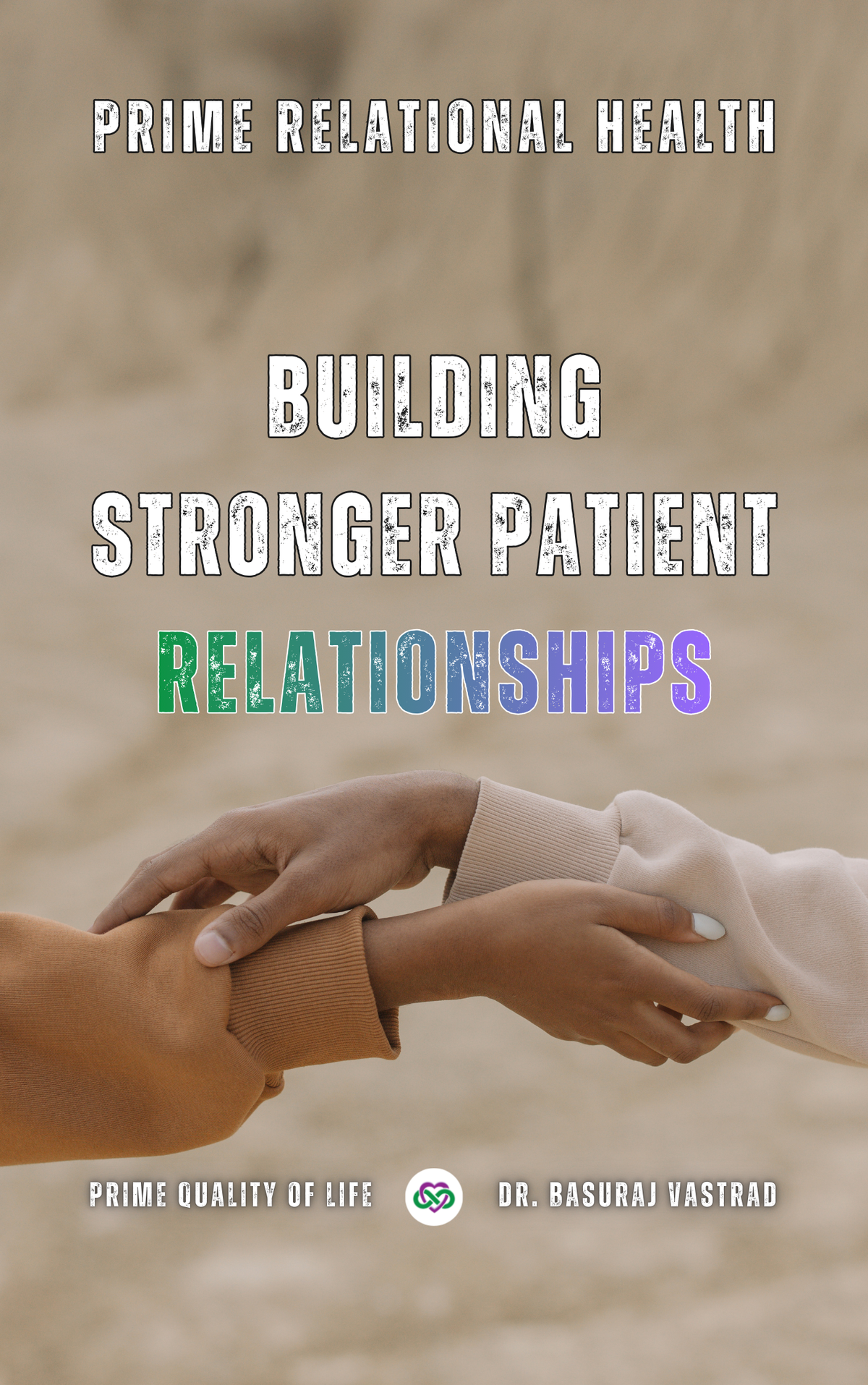
Prime Relational Health: Building Stronger Patient Relationships
Discover how healthcare professionals can build stronger patient relationships through trust, empathy, and effective communication.

The Importance of Patient Relationships
Medicine has become increasingly technological, data-driven, and efficient. Electronic health records, evidence-based protocols, standardized workflows — all valuable advances. But somewhere in the optimization, we risk losing what remains the heart of healthcare — the therapeutic relationship between provider and patient.
Research consistently shows that the quality of the patient-provider relationship significantly impacts:
- Treatment adherence
- Health outcomes
- Patient satisfaction
- Medical error rates
- Malpractice claims
- Provider satisfaction and burnout
Patients remember how you made them feel long after they forget the specific medical details. The physician who listened. The nurse noticed they were scared. The therapist who saw them as a person, not a diagnosis.
Strong patient relationships aren't a luxury for when you have extra time — they're fundamental to effective healthcare. And contrary to popular belief, building them doesn't necessarily require more time. It requires presence, skill, and intention.
The most successful health professionals don't view relationship-building as separate from medical care. The relationship is the vehicle through which care happens.
Active Listening
Most of us listen just enough to formulate our response. We're already thinking about the diagnosis, the next question, the treatment plan, or the next patient waiting.
True listening — the kind that builds therapeutic relationships — is different.
What Active Listening Actually Means
Active listening is:
- Full attention on the person speaking
- Hearing both content and emotion
- Reflecting back what you've heard
- Asking questions to deepen understanding
- Resisting the urge to interrupt or fix prematurely
The Barriers to Active Listening in Healthcare
Time Pressure
"I have seven minutes with this patient."
Cognitive Load
You're processing complex information while trying to listen.
Emotional Protection
Sometimes not listening fully is self-protection from overwhelming stories.
Assumptions
"I've heard this before; I know what they're going to say."
Distraction
The EHR screen, the next patient, the colleague texting you.
Acknowledging these barriers is the first step to working with them.
Practical Active Listening Techniques
Give Undivided Attention
When the patient is speaking, stop typing. Make eye contact. Turn your body toward them. These small acts communicate: "You have my full attention right now."
If you must use the computer, narrate what you're doing: "I'm documenting what you're telling me so I don't miss anything."
Minimal Encouragers
Small verbal and non-verbal cues that signal you're engaged:
- "Mm-hmm"
- Nodding
- "Tell me more about that"
- "And then what happened?"
These keep the patient talking without interrupting their flow.
Reflective Listening
Periodically summarize what you've heard:
- "So what I'm hearing is..."
- "It sounds like you're worried about..."
- "Let me make sure I understand..."
This serves three purposes:
- Confirms you're understanding correctly
- Allows the patient to clarify or correct
- Makes the patient feel truly heard
Silence
Resist filling every pause. Silence gives patients space to think, feel, and share what's really on their mind. The most important information often comes after a pause.
The "Last Thing" Phenomenon
Research shows patients often share their most important concern last — sometimes literally at the door ("Oh, one more thing...").
Prevention: "What else is worrying you?" or "What haven't I asked about that I should have?" early in the conversation creates space for important issues.
Empathy and Compassion
Empathy and compassion are related but distinct. Both are essential.
Empathy
Understanding and resonating with another's experience. "I sense what you're feeling."
Compassion
Empathy plus the desire to help alleviate suffering. "I want to help."
Why They Matter Clinically
Patients who feel their provider has empathy:
- Disclose more complete histories
- Follow treatment plans more consistently
- Have better health outcomes
- Report higher satisfaction
- Are less likely to file complaints or lawsuits
Empathy isn't just nice — it's clinically effective.
Expressing Empathy
Name the Emotion
"This seems really overwhelming" or "I can see you're frustrated."
Simply naming what someone is feeling creates connection. It says: "I see you."
Validate the Experience
"It makes complete sense that you're worried" or "Anyone in your situation would feel anxious."
Validation doesn't mean you agree with everything — it means you acknowledge the legitimacy of their experience.
Normalize When Appropriate
"Many people in your situation feel..."
This reduces isolation and shame around difficult emotions.
Acknowledge What You Can't Change
Sometimes the most compassionate thing is honest acknowledgment — "I wish I could give you a better answer" or "This is really hard, and I can't take that away."
The NURSE Mnemonic for Empathic Responses
Name: "This sounds frustrating."
Understand: "I can understand why you'd feel that way."
Respect: "I appreciate you sharing this with me."
Support: "I'm here to help you through this."
Explore: "Tell me more about what concerns you most."
Compassion Fatigue vs. Sustainable Compassion
You can't maintain deep empathy for every patient every day without burning out.
Sustainable compassion means:
Bounded Empathy
You care deeply in the moment but don't carry everyone's suffering home.
Self-Compassion
Treating yourself with the same kindness you extend to patients.
Emotional Granularity
Recognizing which situations genuinely require deep emotional engagement vs. professional warmth.
Recovery Practices
Intentional ways to discharge emotional accumulation.
Compassion is renewable when you care for yourself as carefully as you care for others.
Clear Communication
Medical information is complex. Patients are often scared, overwhelmed, or in pain — all states that reduce comprehension.
Clear communication bridges this gap.
Health Literacy Reality
Most patient education materials are written at 10th-12th grade level. The average American reads at 7th-8th grade level. During stress, comprehension drops 2-3 grades.
This isn't about intelligence — it's about cognitive load during a crisis.
Principles of Clear Communication
Plain Language
Replace jargon with everyday words:
- Not "myocardial infarction" → "heart attack"
- Not "hypertension" → "high blood pressure"
- Not "contraindication" → "shouldn't be used with"
When technical terms are necessary, explain them simply.
Chunk Information
Human working memory handles 3-5 pieces of information at once.
Instead of "You have diabetes which means your blood sugar is too high which can damage your kidneys, eyes, nerves, and heart, so you need to check your blood sugar daily, take this medication twice a day, follow this diet, exercise 150 minutes weekly, see a podiatrist, get annual eye exams..."
Try "Today we'll focus on three things. First, understanding what diabetes means..."
Teach-Back Method
Instead of "Do you understand?" (everyone says yes), try:
"I want to make sure I explained this clearly. Can you tell me in your own words what you'll do when you get home?"
This reveals gaps without shame and ensures actual comprehension.
Visual Aids
Draw pictures. Use diagrams. Show them what you mean. Visual information is processed differently than verbal and often sticks better.
Written Summary
Give them something to take home. Verbal information is forgotten quickly, especially under stress.
Addressing the Whole Message
Communication includes:
- Words
- What you say
- Tone
- How you say it
- Body Language
- What your posture, facial expressions, and gestures communicate
Saying "I have time for your questions" while glancing at your watch sends a mixed message. Consistency matters.
Difficult Conversations
Delivering Bad News
- Find a private, quiet space
- Sit down (standing communicates rushing)
- Warning Shot: "I have some concerning news..."
- Be Direct But Kind: "The tests show cancer"
- Pause. Let them process.
- Use silence. Don't fill it.
- "What questions do you have?"
- "What support do you need?"
Explaining Uncertainty
Medicine often lacks clear answers. Admitting this builds trust.
"I don't know yet, but here's what we'll do to find out" is more trustworthy than false certainty.
Breaking Through Denial
When a patient isn't accepting reality:
- Don't argue
- Express concern: "I'm worried about..."
- Ask permission: "Would you be open to discussing what might happen if we don't address this?"
- Plant seeds without forcing acceptance
Setting Boundaries
Healthy relationships require boundaries. Patient relationships are no exception.
Why Boundaries Matter
Boundaries protect:
- Your time and energy
- Professional objectivity
- Appropriate roles
- Your capacity to serve many patients, not just demanding ones
Without boundaries:
- You burn out
- Resentment builds
- You provide worse care
- Other patients suffer
Common Boundary Challenges
Time Boundaries
The patient who shows up late but expects a full appointment. The phone call at 9pm for non-urgent issues. The conversation that extends 20 minutes beyond scheduled time.
Emotional Boundaries
The patient who wants you to be their friend, therapist, or family member. The personal questions that feel inappropriate. The dependency that exceeds clinical necessity.
Professional Boundaries
Requests for special treatment. Pressure to prescribe outside your clinical judgment. Manipulation through guilt or flattery.
Setting Boundaries with Compassion
Boundaries can be firm and kind simultaneously.
State The Boundary Clearly
"I can give you 15 minutes today. Let's make the most of that time."
Explain The Why When Appropriate
"I need to end on time because I have other patients waiting who also need my care."
Offer Alternatives
"I can't talk now, but you can schedule an appointment" or "I can't prescribe that, but here's what I can offer."
Be Consistent
Boundaries that constantly shift confuse everyone and invite testing.
Don't Apologize for Appropriate Boundaries
"I'm sorry, but..." undermines the boundary. Just state "I'm available during office hours. For after-hours emergencies, here's the number to call."
When Patients Push Back
Some patients will test boundaries. This doesn't mean your boundaries are wrong — it means they're necessary.
Stay calm. Restate the boundary. Follow through with consequences if needed (ending appointment, referring to another provider, etc.).
The patients who most test boundaries often need them most.
Patient Education
Informed patients are empowered patients. But education only works if patients can understand, remember, and apply it.
Adult Learning Principles
- Adults learn best when:Information is immediately relevant to their life
- They understand *why* it matters
- They're actively involved, not passive recipients
- Information connects to what they already know
- They can practice and apply it
Effective Patient Education Strategies
Start With Their Questions
“What would you most like to understand about your condition?"
This ensures you're addressing what actually matters to them.
Connect To Their Life
Instead of abstract concepts, use their specific situation:
Not: "Diabetes can cause complications"
But: "If we don't manage your blood sugar, you might not be able to keep working as a carpenter because of nerve damage in your hands."
Use Analogies
Complex concepts become clear through familiar comparisons:
"Your heart is like a pump. Right now, it's working too hard because..."
Prioritize
Don't try to teach everything at once. What are the 2-3 most critical things they need to know today?
Multiple Modalities
- Verbal explanation
- Written materials
- Diagrams or models
- Videos
- Apps or online resources
- Support groups
Different people learn differently. Offer options.
Motivational Interviewing
Rather than telling patients what to do, help them discover their own motivation.
Open-Ended Questions
"What concerns you most about this diagnosis?"
Affirmation
"You've already made some really positive changes."
Reflective Listening
"It sounds like you want to get healthier but you're not sure where to start."
Summary
"Let me make sure I understand what you're thinking..."
Change Talk
Listen for and amplify any statements about change:
- "I know I should quit smoking"
- "I want to be healthy for my grandkids"
These are openings to explore motivation.
Better Relationships, Better Care
Strong patient relationships aren't built through grand gestures.
They're built through consistent small practices:
- Looking someone in the eye
- Calling them by name
- Remembering what they told you last visit
- Explaining things clearly
- Expressing genuine care
- Respecting their time and autonomy
- Being honest, even when it's hard
- Following through on what you said you'd do
The most technically excellent care delivered without a relationship is incomplete. Patients need both competence and connection.
Research shows patients can forgive clinical errors when they trust the relationship. But they rarely forgive relationship failures, even when clinical care is perfect.
You entered healthcare to help people. The quality of your relationships with patients largely determines how effectively you can do that.
Strong relationships don't require extra time — they require full presence during the time you have. They don't require you to be perfect — they require you to be genuine. They don't demand you solve every problem — they ask you to see every person.
The patient in front of you right now is someone's mother, father, child, or friend. They came to you during one of the most vulnerable moments of their life. That's a profound trust.
How will you honor it?
What one relationship skill will you practice this week?
Related Reading
- Prime Physical Health: 10 Habits of Highly Effective Health Pros
- Prime Mental Health: Managing Stress in High-Pressure Professions
- Prime Spiritual Health: Finding Purpose in Your Health Career
- Prime Emotional Health: Emotional Intelligence for Health Leaders
- Prime Financial Health: Financial Wellness for Health Professionals
- Prime Social Health: Networking Strategies for Health Pros
- Prime Factor P — Free eBook — Claim Free eBook
- Prime A-Z Formulas For A Prime Life — Special Gift — Claim Special Gift
About Dr. BasuRaj Vastrad
Dr. BasuRaj Vastrad is the Founder and CEO of Prime Quality of Life, a Physician-Philosopher, former Orthopaedic Hand and Micro-Surgery Consultant, Author, and International Speaker dedicated to helping individuals unlock their fullest potential and live a truly Prime Life.
Through decades of experience in coaching, consulting, and mentoring, he has guided individuals worldwide to design lives of health, happiness, wealth, fulfillment, and purpose. His uniquely integrated approach blends practical strategies, personal insight, and holistic development to help people create meaningful transformation in both personal and professional life.
Dr. BasuRaj is the creator of the Prime Quality of Life Framework, a holistic philosophy centered on purposeful living, resilience, mindfulness, innovation, empowerment, growth, fulfillment, and legacy.
Prime Quality of Life Philosophy
“Love What You Do and Do What You Love”
Learn More:
https://primequalityoflife.com/
https://www.amazon.com/author/dr_basuraj_vastrad/
https://shop.primequalityoflife.com/
https://primequalityoflife.lpages.co/primelifemagazine/
Contact Us at info@primequalityoflife.com – for any updates, feedback, comments, or questions.
Explore more insights on health, purpose, and elevated living at Prime Life Magazine.
Disclaimer
The content published on this website is for general informational and educational purposes only and should not be considered professional advice. While we strive for accuracy, readers are encouraged to verify information and seek appropriate professional guidance before making decisions based on the content.
© Prime Life Magazine
Part of the Prime Quality of Life® and Prime Life Media Series
Prime Quality of Life® — Copyright © 2026 . All Rights Reserved